

Decision Support Tool Overview
This online book resource outlines the Decision Support Tool. You can use the navigation to access the different chapters.
3. Background to Collaboration
The attraction of collaboration is self-evident. Through collaborative processes and arrangements, agencies tap into the distinctive competencies, resources and connections of partner agencies and through stronger relationships bring collective expertise to bear on ‘wicked problems’, be more productive through greater efficiencies and economies of reduced duplication and finally be more innovative in leading transformational and sustainable change.
The cult of collaboration (O’Flynn, 2009) is also fuelled, in large part, by the policy imperatives and mandates of government officials and the stipulations of their funding allocations as well as need for the NFP sector to remain legitimate to influence decision making processes and funding allocations. So pervasive has become collaboration that it has become an elastic term referring generally to any form of ‘working together’. This lack of specificity about collaboration and its practice means that it risks being reduced to mere rhetoric without sustained practice or action.
Collaboration has been presented as a new and all-encompassing approach to address the myriad of problems and conditions confronting contemporary society. Such a position overlooks both the long history of collaborative practice and existence of a suite of possible integration mechanisms which might equally be applied. Although there is a compendium of terms (Lawson, 2002) this review will focus on three most commonly used: collaboration, coordination and cooperation – the 3Cs (Brown and Keast, 2003).
Cooperation, coordination and collaboration are located at different points on a continuum of integrative mechanisms, depending on their level of intensity of the linkages and their degree of formality or informality that that governs the integration activities/relationships (Keast et al, 2007). Based on this, a proposed integration continuum is presented in figure 1 (below).
Table 1: Core Horizontal Integration Relationships
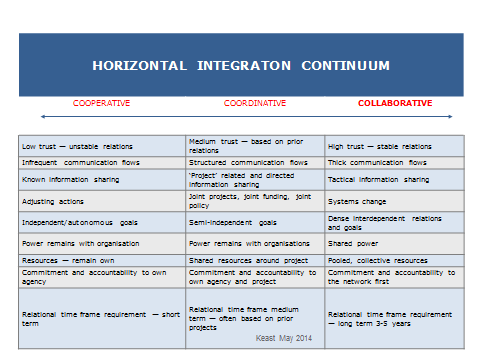
Thus, while these terms, and others as Lawson has defined as the compendium of Cs (Lawson, 2002), are often used interchangeably (Fine, 2001; Szirom, 1998) they are increasingly understood to be analytically distinct (Winer and Ray, 1984; Himmerman, 2002). Your organisation's place along this continuum will depend on the resources you have available and the capacity or willingness to cultivate relationships with other organisations.